

Introduction
Despite advances in the area of prosthetic technology, the incidence of falls among lower-limb prosthetic users (LLPUs) remains high. Over 50% of people with this medical case experience at least one fall every year, with more than a ¼ reporting that their fall resulted in injury. This issue not only prevents LLPUs from living a quality life but also contributes to higher costs of healthcare.
In a study that involved prosthetic users, almost 60% of them reported an inability to walk on uneven ground and a lack of support for balance. LLPUs must always focus on their movements, which increase cognitive load. In order to navigate uneven terrains, they heavily depend on visual input and employ predictive and compensatory strategies to maintain better balance.
Breakthrough
Just recently, the solution was upgraded to a new level after one of the technical events – G7 Salute – organised by the Ministry of Health, Italy, in collaboration with the Italian Institute of Technology, held in Genoa. The Institute of Technology has presented a new artificial food prototype – SoftFoot Pro – designed by the Soft Robotics for Human Cooperation and Rehabilitation Unit of the Institute.
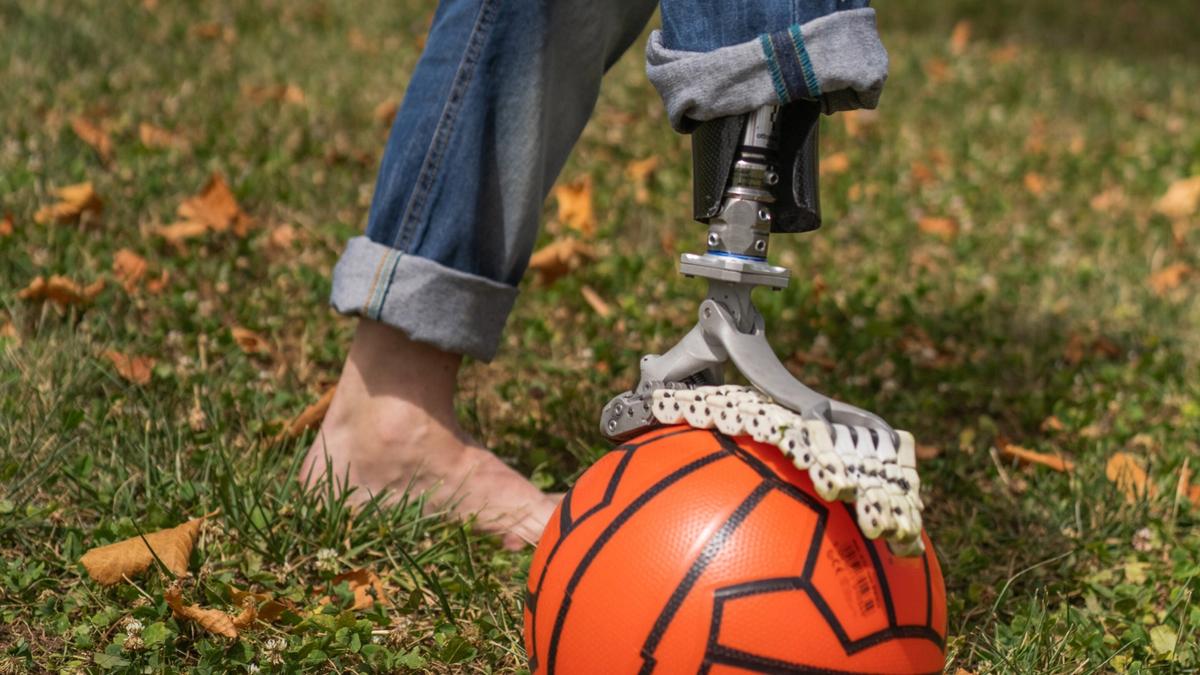
SoftFoot Pro is a prosthetic foot that possibly provides ground adaptation across all terrains. The project stems from an artificial adaptive foot, the SoftFoot, developed for a legged robotic system, which was then designed according to a soft robotics approach. It was developed to overcome the drawbacks of state-of-the-art robotic flat feet in an unstructured environment.
SoftFoot Pro
It is a motorless, flexible, waterproof prosthetic foot inspired by the anatomy of the human. SoftFoot ensures maximum performance even in outdoor settings such as lawns.
It is composed of a titanium arch mechanism, the ends of which are connected by five high-strength plastic chains arranged in parallel to simulate the bone structure of the human foot.
A unique feature of SoftFoot Pro is the eclectic components that connect the artificial tarsus, metatarsus, and phalanges, which form an equivalent to the plantar fascia of the human foot.
“ Observing people with prosthetic feet and humanoid robots walking in our laboratories, we noticed a less than fluid gait due to the characteristic flat and rigid sole of the feet of both, developed to ensure maximum support, but unable to adapt to changes in slope, the conformation of the terrain and different poses such as kneeling or bending ” explains Manuel G. Catalano, researcher at the IIT SoftBots Laboratory.
The Human Impact
Several prototypes of SoftFoot Pro have already been tested on people with unilateral lower limb amputations in international collaborations with the Hannover Medical School (MHH, Hannover, Germany) and the Medical University of Vienna (MUV, Vienna, Austria), as part of several European projects and in particular the European ERC project Synergy: Natural Bionics.
SoftFoot Pro allows lower-limb prosthetic users to improve their mobility by mimicking natural foot biomechanics. It enhances stability on uneven terrain, absorbs 10%-50% of impact energy, and increases energy efficiency, reducing the physical burden and discomfort often caused by traditional prosthetic feet.
Final Words
By exploring this example of medical robotics, we can acknowledge how the integration of engineering and medicine offers life-changing opportunities for those struggling with physical limitations and health challenges.







Leave a Reply