

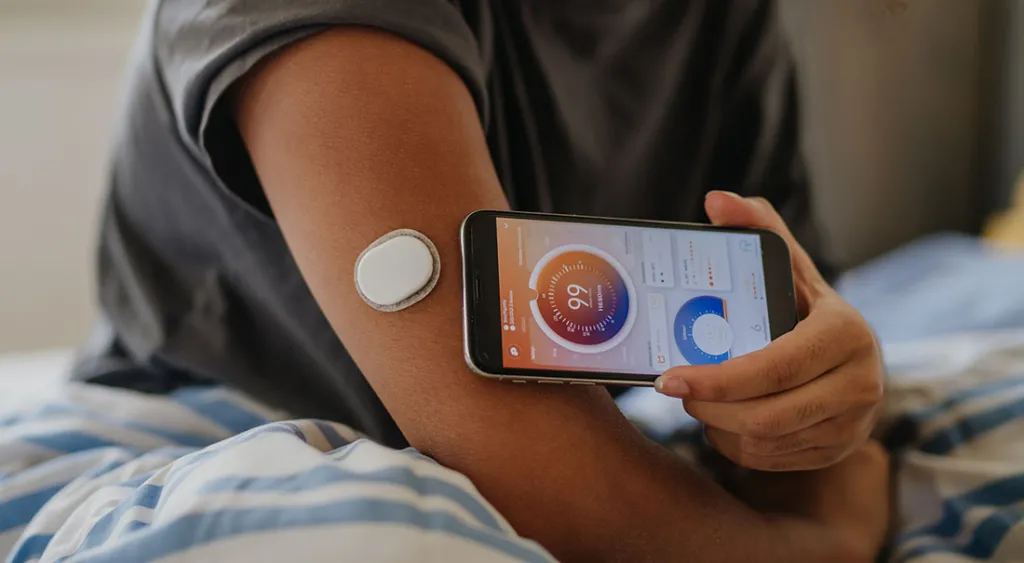
People with diabetes should keep in mind that managing their health condition (diabetes) involves managing the level of sugar (glucose). Glaucous level depends on several factors, some of which cannot be predicted. That is why it is important to check your sugar level several times per day.
In the past, it was hard for people to track their blood sugar levels and prevent glucose spikes, as there were no real-time medical devices like the Continuous Glucose Monitoring (CGM) systems that we have today.
Continuous Glucose Monitoring (CGM) is a wearable technology that tracks your glucose (sugar) level over time. It measures the glucose level in the interstitial fluid just under your skin 24 hours a day while you are wearing the device. The tool is mainly for those with diabetes.
Over the years, this kind of device evolved into different types. Some CGMs connect with insulin pumps to offer automated insulin delivery systems.
Interstitial fluid
Interstitial fluid is a liquid that surrounds your body cells, filling the spaces around your cells. It is one of the forms of extracellular fluid. The liquid is a space between blood vessels and body cells. It comes from substances that leak out of your blood capillaries. One of the substances is glucose (sugar).
A CGM sensor goes under your skin, where the interstitial fluid is (not in a blood vessel, as some people think). It measures the glucose in your interstitial fluid.
As glucose hits your bloodstream first and then leaks into your interstitial fluid, there can be a lag between your body’s blood glucose level and interstitial glucose level. This means that there may be a few minutes (about 10 min) delay in your CGM sensor glucose reading compared with fingerstick (manual) blood glucose readings.
All CGMs have 3 basic components:
- Sensor: it is a tiny piece of material that measures glucose level in your interstitial fluid in real time. You will need to insert it under your skin with an applicator. It uses a needle to go under your skin. Sensors typically last 7 to 15 days, depending on the brand. The implantable system for CGM lasts for months.
- Transmitter: All CGM systems use a transmitter in order to wirelessly send the glucose data from the sensor to a device where you can view it.
- Smartphone app, receiver, or insulin pump: This will allow you to monitor your glucose level in real time as technology shows a graph of the history of your levels. What is more, it shows whether your glucose level is trending up or down and how significantly this is happening. Most CGMs provide certain apps for downloading and then getting all the data. Others may offer handheld devices if you do not use a smartphone. Additionally, some CGMs can send a signal to a compatible insulin pump.
How does CGM work?
- You insert a small sensor just under your skin, usually on the lower part of your belly or arm.
- You will need to connect the CGM transmitter to the sensor, or the sensor and transmitter will already be connected when you insert it. You must charge some transmitters before connecting them to the sensor.
- Note that it could require sometime about 30 min before the sensor shares data. The duration of time depends on the type of CGM.
- After that, you will be able to see your current glucose level on your smartphone app or receiver for as long as the sensor lasts. You can set certain alarms and settings for your app, receiver to get some alert signs when your glucose level is out of range. Ranges can differ from person to person.
- Once the sensor expires or fails, you will start the process over again.
Does it mean that you can forget about fingerstick checks?
Using CGM will allow you to decrease the number of times you need to do a fingerstick. However, it is still important to have a fingerstick meter on hand. If your CGM fails unexpectedly, you can use a fingerstick meter to check your sugar level while managing your CGM.








Leave a Reply