

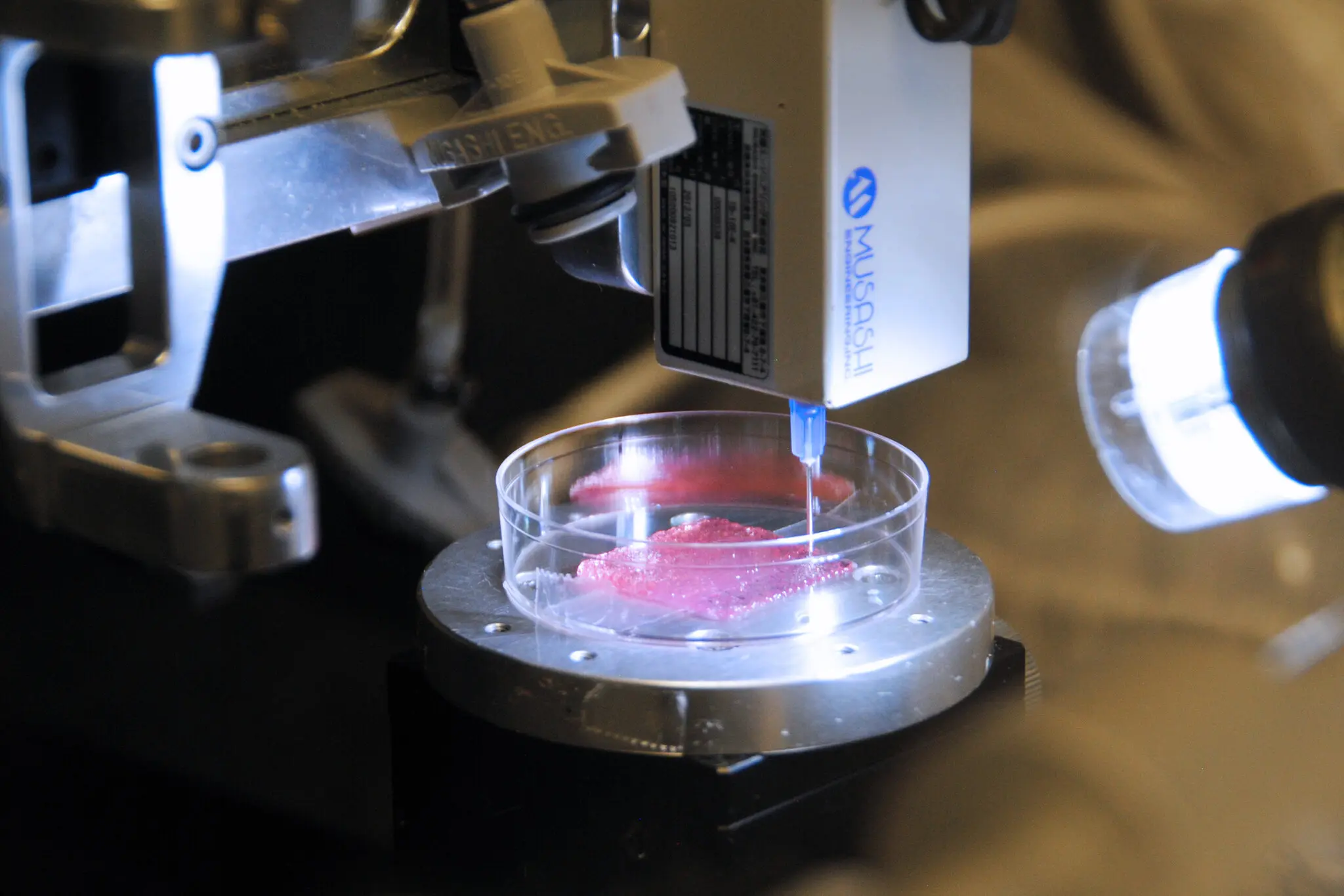
Imagine a child who has just suffered severe burns. The treatments we use today, which consist of skin grafts, long recoveries, and painful procedures, are lifesaving but far from perfect. Now picture a doctor being able to take a small sample of that child’s own cells, feed them to a specialized 3D printer, and print a new sheet of skin that’s personalized to the child’s original tissue, fits seamlessly, reduces scarring, and speeds recovery. This isn’t just a narrative in science fiction anymore. It’s the growing reality of bioprinting.
At its core, bioprinting is the process of using “bioinks,” which are a mix of living cells, supportive materials, and growth factors to print layers of tissue based on a digital design. It’s the same principle as a 3D printer, but instead of plastic, the “ink” is alive. What makes this revolutionary is not just the technology but the promise: healing with a patient’s own biology, reducing rejection, and potentially ending the desperate wait for donor organs.
Researchers are already making advancements in areas where tissues don’t need complex blood vessel networks to survive. Skin, cartilage, and small patches of heart muscle are some of the leading examples. In fact, an Australian team recently showed that lab-grown skin, derived from a patient’s own cells, can be used in burn treatment trials with positive results, integrating into the body and reducing scarring. Similar experiments with heart patches have improved heart function in animal models, hinting at what could soon be possible for people recovering from heart attacks. But printing tissue isn’t as easy as hitting “print.” One of the greatest challenges is vascularization; ensuring that tissues thicker than a few sheets of paper can get a blood supply fast enough to stay alive. Scientists are exploring competent solutions, like printing expiratory materials which dissolve to leave tiny channels for blood, or co-printing blood vessel cells to encourage networks to form naturally. Others are “training” tissues in dynamic cultures, stretching, pulsing, or electrically stimulating them to do more and more of the same.
The advancement is encouraging, but expectations should remain humble. Bioprinted patches and grafts could make their way into hospitals over the next decade, but fully functional printed organs, like hearts, kidneys, and livers, are still way off. Between technical hurdles, regulatory supervision, and moral considerations of access and cost, it truly is a marathon. Even still, even the smallest of steps would have amazing consequences. Imagine drug companies applying treatments to the bioprinted human liver tissue instead of animals, as data that is more reliable and authentic, or bioprinted cartilage for a patient with arthritis that restores mobility. They aren’t just daydreams. They’re tangible, near-future applications that can reshape medicine, one layer of tissue at a time.
Bioprinting carries the weight of hope. Hope for patients who wait years for an organ transplant that may never come. Hope for children with burns who might grow up without the scars that mark their trauma. And hope for a healthcare system that can heal not just with scalpels and drugs, but with tissues grown from the very people it seeks to save.
The future of healing may not come from a donor list, but from a printer.








Leave a Reply